You pull it out. It comes back. You mow over it. It keeps spreading. Before long, what started as a small patch has worked its way through a surprising amount of your lawn.
If that sounds familiar, you’re probably dealing with Creeping Charlie.
Also known as ground ivy, Creeping Charlie is a persistent perennial weed that is common in Minnesota lawns. Once established, it can spread aggressively and compete with turfgrass, particularly in areas where the lawn is already struggling.
If you’re wondering why Creeping Charlie is taking over your lawn, the answer usually involves more than the weed itself. The conditions that allow Creeping Charlie to thrive may also be making it difficult for your grass to compete.
What Is Creeping Charlie?
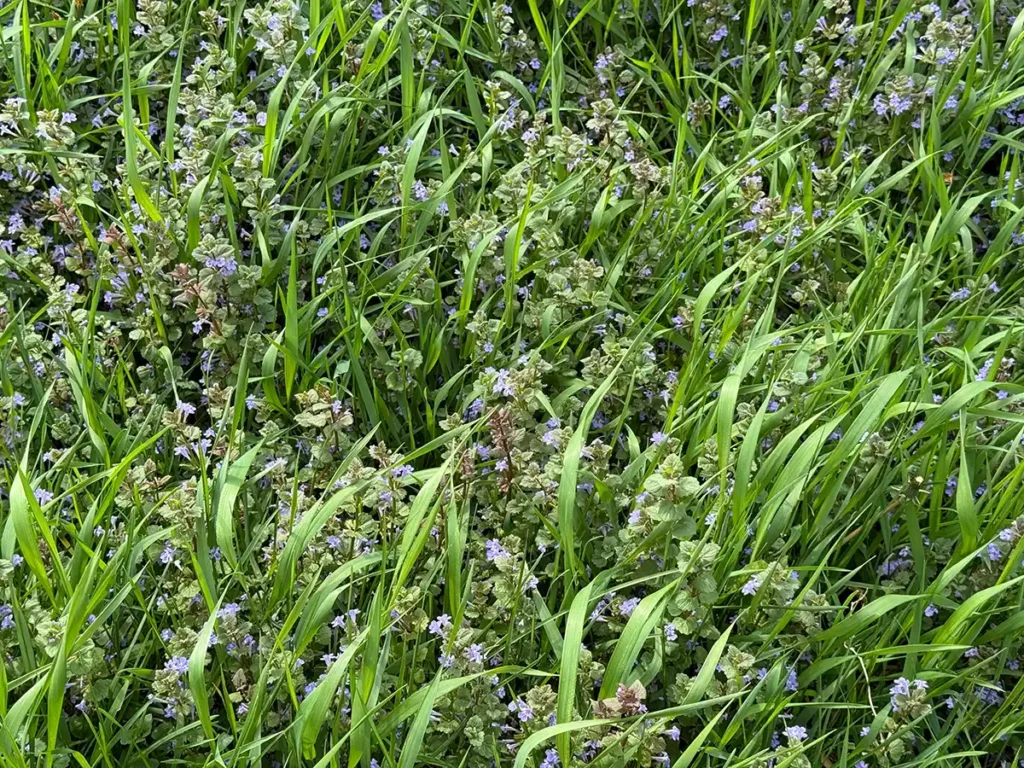
Creeping Charlie is a low-growing perennial broadleaf weed. It has rounded leaves with scalloped edges and produces small purple or bluish flowers.
But the feature that makes Creeping Charlie particularly troublesome is right there in its name: it creeps.
The plant spreads horizontally across the ground using stems called stolons. Those stems can develop roots where they contact the soil, allowing one plant to establish itself in multiple locations.
That growth habit allows Creeping Charlie to form dense mats that gradually occupy more and more of the lawn.
Why Does Creeping Charlie Spread So Quickly?
Creeping Charlie isn’t relying on a single plant surviving in one location. Its spreading stems allow it to continually establish new growth.
That makes simply pulling the visible portion of the plant frustratingly ineffective.
If sections of the plant or rooted nodes remain behind, Creeping Charlie can continue growing. Once it becomes established throughout a lawn, removing individual plants by hand becomes increasingly difficult.
It is also a perennial, which means established plants can survive from one growing season to the next rather than starting over from seed every spring.
Shade Can Give Creeping Charlie an Advantage
One of the most common places to find Creeping Charlie is in shady areas.
Grass needs adequate sunlight to remain thick and vigorous. Under mature trees, along the north side of buildings or in other heavily shaded areas, turf can gradually become thinner.
Creeping Charlie tolerates shade quite well.
That creates an opportunity. As the grass becomes less competitive, Creeping Charlie can spread into the open spaces.
This is why you may see a lawn that looks relatively healthy in full sun but has large patches of Creeping Charlie underneath trees or along shaded edges.
Moist Soil Can Encourage Creeping Charlie
Creeping Charlie also performs well in moist conditions.
Areas with poor drainage, excessive irrigation or consistently damp soil can provide favorable conditions for the weed.
Combine moisture with shade and thin turf, and you can create an environment where Creeping Charlie has a significant advantage over the grass you’re trying to grow.
That’s why weed control alone may not provide a permanent solution if the underlying conditions remain unchanged.
A Thin Lawn Leaves Room for Weeds
One of the best defenses against weeds is something surprisingly simple: more grass.
A thick, healthy lawn occupies the available space and competes for sunlight, water and nutrients. When turf becomes thin, bare areas appear where weeds can establish themselves.
Creeping Charlie is particularly good at exploiting those openings.
Improving turf density through proper fertilization, mowing, aeration, overseeding and other appropriate lawn care practices can make the lawn more competitive and help reduce opportunities for Creeping Charlie to spread.
Why Doesn’t Mowing Get Rid of Creeping Charlie?
Creeping Charlie grows close to the ground, which allows much of the plant to remain below normal mowing height.
Mowing may remove some leaves or flowers, but it generally doesn’t eliminate the rooted stems spreading through the lawn.
In fact, the grass usually takes more punishment from mowing than the Creeping Charlie does if you’re cutting the lawn too short.
Maintaining an appropriate mowing height helps grass develop a stronger root system and creates a denser canopy that can better compete with weeds.
Why Is Creeping Charlie So Difficult to Pull?
Pulling a small, isolated patch can sometimes be practical, especially if you catch it early.
Once Creeping Charlie has spread throughout a larger area, things become considerably more difficult.
Those long creeping stems can root at multiple points. Pull one section and another rooted section may remain behind.
It doesn’t take much surviving plant material for the weed to begin spreading again.
That’s why homeowners often feel like they have completely removed Creeping Charlie only to see it reappear a few weeks later.
When Is the Best Time to Control Creeping Charlie in Minnesota?
Timing can make a major difference when controlling perennial broadleaf weeds.
Late summer and fall can be particularly important periods for controlling established perennial weeds in Minnesota lawns. As plants prepare for winter, they move energy toward their roots and other storage structures.
An appropriately selected lawn treatment applied at the right time can take advantage of that natural process.
Spring treatments may also be appropriate depending on the condition of the lawn and the extent of the infestation.
The important point is that successful Creeping Charlie control usually isn’t about spraying something whenever you happen to notice the weed. The product, application and timing all matter.
Getting Rid of Creeping Charlie Is Only Half the Job
Suppose you successfully eliminate a large patch of Creeping Charlie.
What happens next?
If the weed was occupying a substantial portion of the lawn, removing it may leave behind thin grass and bare soil. Unless healthy turf fills those spaces, Creeping Charlie or another weed has an opportunity to move right back in.
That’s why effective weed control should be combined with a plan for improving the lawn itself.
Depending on the property, that might include:
- Proper fertilization
- Core aeration
- Overseeding thin areas
- Correct mowing practices
- Improved watering practices
- Addressing drainage problems
- Improving conditions in heavily shaded areas
The goal isn’t simply to kill Creeping Charlie. It’s to create a lawn where healthy grass has a better chance of winning the competition for space.
Why Does Creeping Charlie Keep Coming Back?
If you’ve treated Creeping Charlie repeatedly and it continues returning, look beyond the weed.
Is the lawn thin? Is the area heavily shaded? Does the soil stay wet? Is the grass being mowed too short? Is compacted soil preventing healthy turf development?
If nothing changes except killing the visible weeds, the conditions that allowed Creeping Charlie to become established are still there.
Long-term control means dealing with both sides of the problem: controlling the Creeping Charlie and improving the health and density of the lawn.
Need Help With Creeping Charlie in Your Minnesota Lawn?
If Creeping Charlie is spreading through your lawn in Brainerd, Baxter or the surrounding Lakes Area, TurfCare can help.
We can evaluate the lawn, determine how extensive the problem has become and recommend an appropriate weed-control and lawn-care program. Just as importantly, we can help identify the conditions that may be allowing Creeping Charlie to thrive in the first place.
If you’re wondering why Creeping Charlie is taking over your lawn, don’t wait until a small patch becomes a green carpet stretching across the yard.
Contact TurfCare and let’s help your grass take back the lawn.