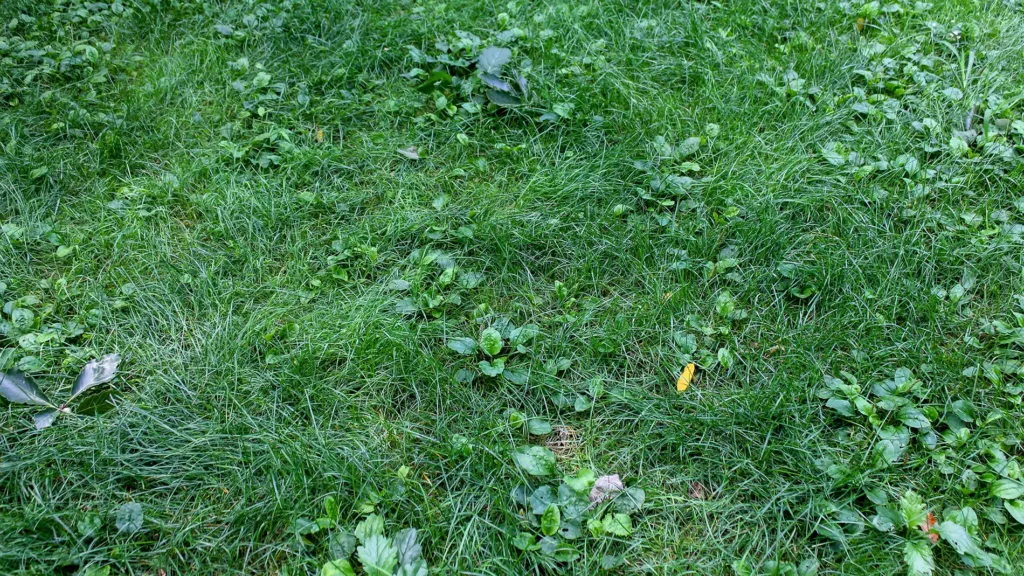
Every Minnesota lawn gets weeds.
The question is whether you’re dealing with a few dandelions scattered across an otherwise healthy lawn or weeds that have started taking over entire sections of your yard.
There’s an important difference between the two.
A few weeds are usually a weed-control problem. A lawn full of weeds is often a lawn health problem. The weeds are simply taking advantage of thin grass, compacted soil, poor growing conditions or bare ground.
Understanding that difference is the first step toward controlling Minnesota lawn weeds for the long term.
Why Do Weeds Take Over Minnesota Lawns?
Weeds are opportunists.
Give them sunlight, exposed soil and enough moisture to germinate, and they’ll happily move in. That’s why the thickest, healthiest parts of your lawn usually have fewer weeds than thin or damaged areas.
Several conditions can make a Minnesota lawn particularly vulnerable to weeds, including compacted soil, mowing too short, drought stress, poor soil fertility, excessive shade, improper watering and thinning turf.
Sometimes killing the weed is the easy part.
Figuring out why it was able to establish itself in the first place is what prevents it from coming back.
Common Minnesota Lawn Weeds
Correct identification matters because different weeds require different approaches. Some are annuals that reproduce from seed. Others are aggressive perennials with root systems that can survive even after the visible plant has been removed.
Here are some of the weeds we commonly see in Minnesota lawns.
Dandelions
Dandelions may be Minnesota’s most recognizable lawn weed.
Their bright yellow flowers eventually turn into the familiar white seed heads that can distribute seeds throughout the neighborhood. But seeds aren’t the only reason dandelions are difficult to eliminate.
Dandelions develop a substantial taproot. Simply pulling off the leaves and flower doesn’t necessarily kill the plant. If enough of the root remains, the dandelion can grow back.
A healthy, dense lawn helps reduce opportunities for new dandelion seeds to establish. Existing plants can be controlled through proper removal or appropriately timed broadleaf weed treatments.
Creeping Charlie
Creeping Charlie, also known as ground ivy, is one of the more frustrating Minnesota lawn weeds.
It grows low to the ground and spreads through creeping stems that can root at multiple points. You’ll recognize it by its rounded, scalloped leaves and small purple flowers.
Creeping Charlie particularly likes moist, shaded areas where turfgrass may already be struggling.
That’s part of what makes it difficult to control. Killing the existing weed without addressing the conditions that favor it can simply create an opening for more Creeping Charlie.
Improving drainage, reducing excessive shade where practical and establishing thicker turf can all be important parts of long-term control.
Crabgrass
Crabgrass is different from many common broadleaf lawn weeds because it is an annual grassy weed.
It germinates in the spring, grows aggressively during warm summer weather, produces seed and dies after frost.
The following spring, the cycle begins again.
This is why crabgrass prevention is so important.
A properly timed pre-emergent treatment can prevent many crabgrass seeds from successfully establishing. Once crabgrass is already growing, your options become more limited.
Timing matters more than the date printed on the calendar. Spring soil temperatures and weather conditions determine when crabgrass begins germinating in Minnesota.
White Clover
White clover is easy to identify by its clusters of three rounded leaflets and small white flowers.
It tends to grow particularly well in lawns with low nitrogen levels, although soil conditions aren’t the only reason it appears.
Some homeowners don’t mind having clover in their lawns. Others want a more uniform turfgrass appearance.
If you’re trying to reduce clover, weed control can address the existing plants, but improving the density and overall health of the grass can make the lawn less inviting for future clover growth.
Plantain
Broadleaf and buckhorn plantain are common sights in Minnesota lawns.
Plantain forms a low-growing rosette of leaves with prominent veins and sends up distinctive seed stalks.
One reason we’re interested when we see a lot of plantain is that it can tolerate compacted soil.
If plantain repeatedly appears in the same areas, particularly along sidewalks, driveways or heavily traveled portions of the yard, soil compaction may be contributing to the problem.
Core aeration can help address that underlying condition while weed control deals with the existing plants.
Thistles
Thistles are considerably less pleasant to discover while walking barefoot across the lawn.
Different thistle species behave differently, but perennial varieties can develop extensive root systems that make them difficult to eliminate by simply cutting or pulling the visible plant.
Repeated mowing may prevent flowering and seed production, but established perennial thistles often require more targeted control.
The earlier they’re identified and treated, the easier the problem generally is to manage.
Wild Violets
Wild violets have heart-shaped leaves and produce small purple, blue or sometimes white flowers.
They can look attractive when they’re growing somewhere you want them.
Inside a maintained lawn, they’re another story.
Wild violets spread through underground structures and can be remarkably persistent. Their waxy leaves can also make some treatments less effective.
They tend to be particularly comfortable in shady, moist areas, which again raises the question of whether the grass itself is growing under ideal conditions.
Nutsedge
Nutsedge often gets mistaken for grass because of its narrow, upright leaves.
Look more closely and it becomes easier to distinguish. Nutsedge typically grows faster than the surrounding lawn and often has a lighter yellow-green appearance.
Despite looking grass-like, nutsedge is actually a sedge.
It commonly appears in wet or poorly drained areas and can spread through underground structures called tubers.
Pulling nutsedge can sometimes make the problem worse if underground portions remain behind and continue producing new growth. Proper identification and targeted treatment are important.
Annual Bluegrass
Annual bluegrass, commonly called Poa annua, can appear as patches of lighter green grass within a darker lawn.
It produces noticeable seed heads, sometimes even when it is mowed relatively short.
Because it’s a grass growing among other grasses, controlling it can be more complicated than controlling a broadleaf weed.
Maintaining healthy turf and avoiding conditions that encourage annual bluegrass can be an important part of managing it.
Why Mowing Height Matters for Weed Prevention
One of the easiest ways Minnesota homeowners can help prevent weeds costs absolutely nothing.
Stop mowing the lawn so short.
Keeping cool-season turf around 3 to 4 inches tall encourages stronger roots and creates a denser canopy over the soil.
That shade matters.
Many weed seeds need sunlight to germinate successfully. A thick lawn physically occupies the space weeds would otherwise use and reduces the amount of sunlight reaching the soil surface.
Cutting the lawn extremely short does the opposite. It stresses the grass while simultaneously giving weeds more opportunity to establish.
Watering Can Affect Weed Problems Too
Frequent, shallow watering encourages shallow root development.
For an established lawn, deeper and less frequent watering generally encourages turfgrass roots to grow farther into the soil.
There are exceptions, particularly when establishing new seed, but constantly keeping the uppermost layer of soil wet can favor certain weeds while doing relatively little to build a stronger established lawn.
Drainage problems are another matter.
If one area stays wet long after the rest of your yard dries, weeds that tolerate wet soil may repeatedly appear there. Treating those weeds without correcting the drainage issue may become an annual ritual.
When Should Minnesota Lawn Weeds Be Treated?
There isn’t one universal weed-control season.
Crabgrass prevention happens in spring before germination.
Many actively growing broadleaf weeds can be treated during the growing season when weather conditions are appropriate.
Fall can be an especially useful time for controlling certain perennial broadleaf weeds because the plants are moving energy toward their roots in preparation for winter.
The best treatment window depends on the weed you’re trying to control.
That’s another reason identifying the weed before treating it is so important.
Why Weed-and-Feed Isn’t Always the Answer
It’s tempting to see weeds and immediately reach for a bag of weed-and-feed.
Sometimes that may be appropriate. Sometimes it isn’t.
Your lawn may need fertilizer when the weeds don’t need treatment. The weeds may need treatment when the lawn doesn’t need fertilizer.
Combining the two simply because they happen to be sold together doesn’t necessarily mean both treatments are needed at exactly the same time.
A targeted lawn care program lets us treat the actual problem rather than applying products the lawn may not need.
Sometimes You Need to Fix the Lawn, Not Just Kill the Weeds
This is the part of weed control that often gets overlooked.
Suppose half of a thin lawn has become covered with weeds.
We can kill the weeds.
Now you have a thin lawn with a lot of bare dirt.
Unless healthy grass fills those spaces, something is going to grow there again. There’s a pretty good chance it will be another weed.
That’s when aeration, overseeding or more extensive lawn renovation may become part of the solution.
The objective shouldn’t simply be to have fewer weeds this month.
The objective is to create a lawn that’s dense and healthy enough that weeds have a difficult time getting established in the first place.
A Healthy Lawn Is Your Best Weed Control
There will probably never be a completely weed-free Minnesota lawn. Weed seeds arrive by wind, animals, lawn equipment and plenty of other routes we can’t control.
But we can make your lawn a much harder place for them to live.
Proper mowing, appropriate fertilization, good watering practices, aeration when needed, overseeding thin areas and correctly timed weed control all work together.
That’s how you move from constantly fighting weeds to maintaining healthy turf.
Need Help With Weeds in Your Minnesota Lawn?
If you’re seeing dandelions, Creeping Charlie, crabgrass, clover or weeds you can’t identify, TurfCare can help.
We provide professional lawn care throughout the Brainerd Lakes Area and can determine what weeds you’re dealing with, why they’re thriving and the best way to control them.
Sometimes the solution is straightforward weed control. Other times the lawn is telling us there’s a bigger problem underneath.
Either way, identifying the problem is where we start.